When an exchange breaks, its status page is where it says so, or doesn't. We collected every incident that six crypto exchanges posted on their public status pages over two years, from 1 October 2024 to 30 September 2026: Coinbase, Kraken, Gemini, Crypto.com, Bitstamp and CEX.IO. Then we lined them up against bitcoin's daily moves.
- 2,911 incidents, 1,947 of them unplanned. Kraken posted the most: 783 unplanned incidents, about one a day. Coinbase posted 591, Gemini 390.
- Wild bitcoin days bring more trouble. On the 20 days bitcoin moved most (5.8% to 14.0%), the six exchanges opened 1.84× as many platform-wide incidents per day as on other days. On the crash of 10 October 2025 they opened 11 unplanned incidents.
- Almost half of unplanned incidents are about one coin or network (46.4%): deposits or withdrawals of one asset delayed, not the exchange itself.
- "Critical" means different things on different exchanges. Bitstamp labels 62% of its unplanned incidents critical; Crypto.com rates 98% "none".
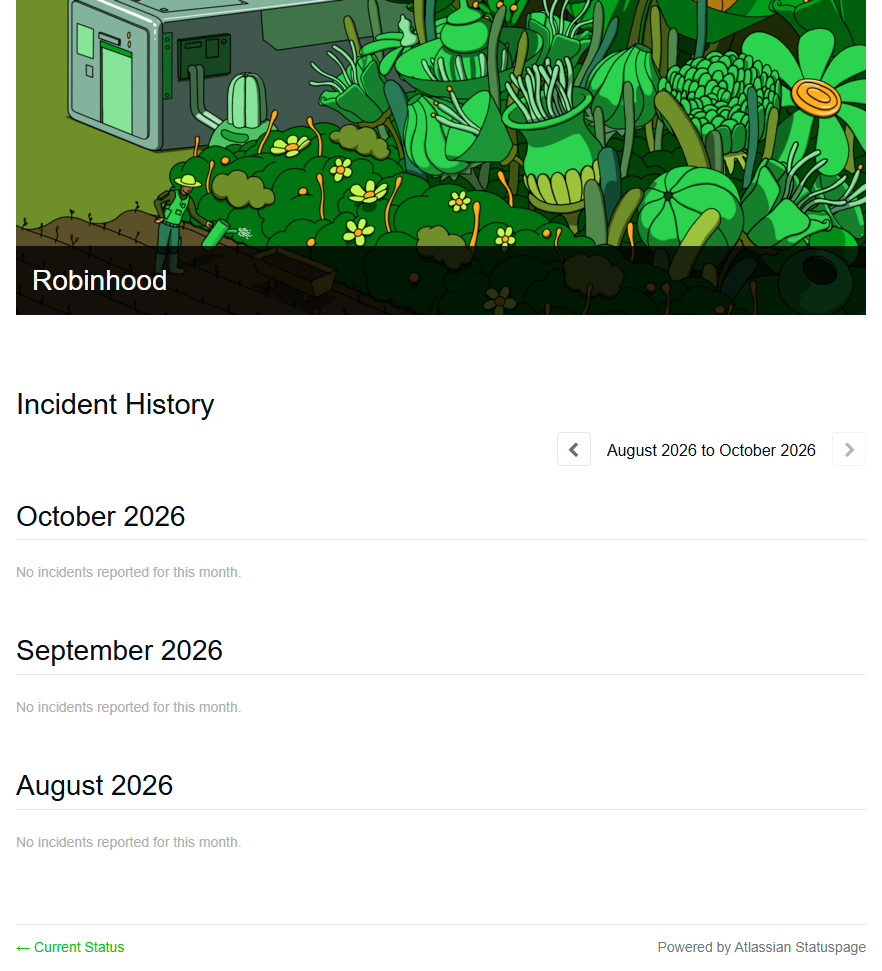
- One status page has gone quiet. Robinhood's hasn't posted an incident since 25 April 2022.
Surviving big moves is a crucial job for an exchange. In the October 2025 crash about $19 billion in positions were liquidated, and many traders said they couldn't close theirs in time. Binance later paid about $283 million back to traders liquidated while holding coins that lost their peg. And it isn't only crashes: after about $6.3 billion was stolen from Binance on 29 October 2026, withdrawals stayed closed for more than two days. Binance isn't one of the six here and that came after our data ends, but it shows what's at stake when you can't get your money out.
| Exchange | Incidents posted | Unplanned | Planned maintenance | Unplanned per month | Median length (unplanned) | Platform-wide share |
|---|---|---|---|---|---|---|
| Kraken | 1,223 | 783 | 440 | 32.6 | 4.4 h | 42% |
| Coinbase | 643 | 591 | 52 | 24.6 | 2.6 h | 31% |
| Gemini | 620 | 390 | 230 | 16.3 | 4.3 h | 66% |
| Crypto.com | 188 | 115 | 73 | 4.8 | 2.6 h | 51% |
| CEX.IO | 174 | 34 | 140 | 1.4 | 4.1 h | 59% |
| Bitstamp | 63 | 34 | 29 | 1.4 | 2.6 h | 65% |
| All six | 2,911 | 1,947 | 964 | 81.1 | 3.6 h | 45% |
A busy status page isn't a worse exchange
These numbers are what each exchange chose to post. Kraken and Coinbase post a separate incident for each coin whose deposits or withdrawals are delayed: 371 of Kraken's unplanned incidents and 384 of Coinbase's are about a single asset or network. An exchange that posts less may have fewer problems, or may just say less. A count of posts can't tell those apart, so read the table as a measure of openness as much as of trouble.
The mix differs a lot. Nearly two thirds of Coinbase's unplanned posts are about single networks (384 of 591); two thirds of Gemini's are about its own platform (258 of 390). CEX.IO files 80% of its posts as planned maintenance.
On wild bitcoin days, more breaks
We took the 20 days in those two years when bitcoin's price moved most from one day's close to the next on Binance (5.8% to 14.0%, up or down) and compared them with the other 710 days.
| Wild days | Other days | Ratio | |
|---|---|---|---|
| Unplanned incidents opened per day (all six exchanges) | 3.80 | 2.64 | 1.44× |
| … platform-wide incidents only | 2.15 | 1.17 | 1.84× |
Is that just chance? We drew 20,000 random sets of 20 days from the same two years. Only 1.1% of them had as many incidents per day as the wild days, and only 0.1% as many platform-wide incidents (one-sided permutation test). So the link is real, though smaller than we expected: we had predicted twice as many.
The busiest of the wild days was 10 October 2025, when bitcoin fell 7.3%: 11 unplanned incidents across the six, among them Kraken's "Connectivity Issues - Web & Mobile - Heavy Load" and a 6-minute "Connectivity Issues - Derivatives" (rated critical), CEX.IO's "Service Performance May Vary Due to Increased Load", Coinbase's "Degraded performance" and Gemini's "Crypto Withdrawals Delayed". That evening, USDe briefly fell to $0.65 on Binance.
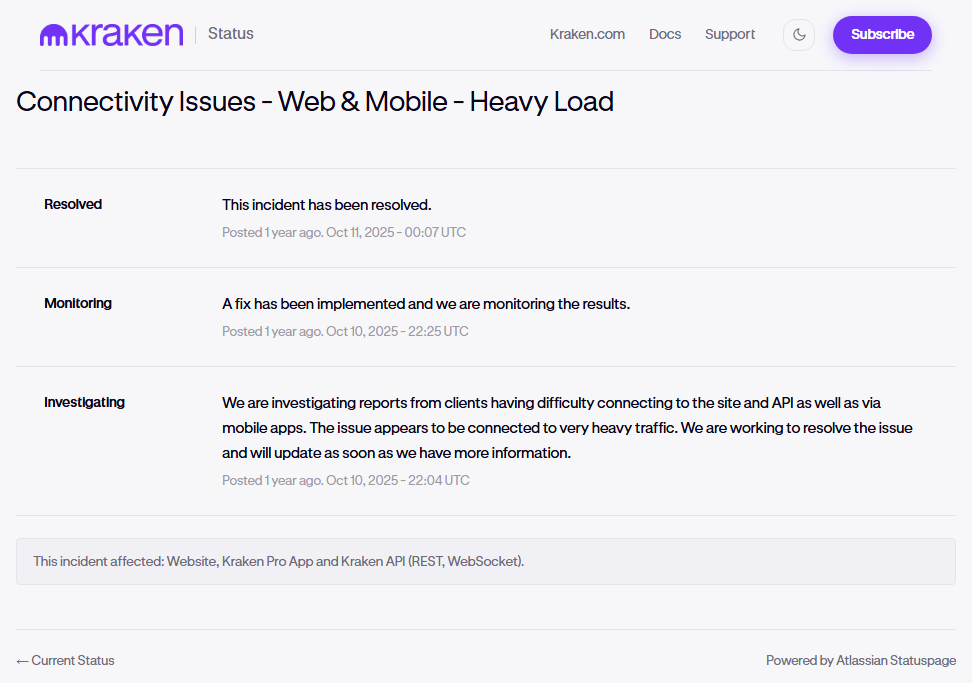
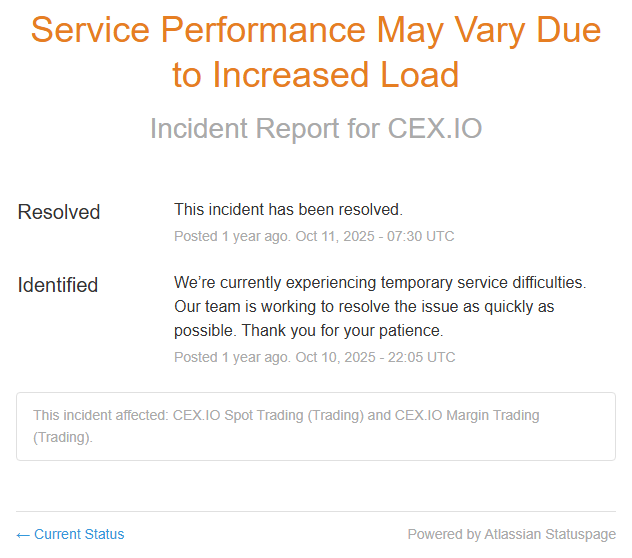
Not every wild day broke something: on 9 March 2025 (bitcoin -6.4%) none of the six posted an unplanned incident. On the biggest move of the two years, -14.0% on 5 February 2026, they posted four.
What breaks: one coin, the platform, or the bank
| Kind | Unplanned incidents | Share | Median length |
|---|---|---|---|
| One coin or network (deposits, withdrawals, staking of one asset) | 903 | 46.4% | 4.7 h |
| The platform (login, trading, the app, an API) | 873 | 44.8% | 2.6 h |
| Fiat and banking (cards, bank transfers) | 171 | 8.8% | 3.8 h |
Platform problems get fixed faster (median 2.6 hours) than single-coin problems (4.7 hours). The long tail is long: 404 of 1,941 resolved unplanned incidents stayed open more than a day, 132 more than a week, and one in ten over 99 hours. The longest stayed open for months: a coin's trading halted, a staking reward delayed, a bank-wire service under maintenance.
"Critical" isn't a unit
Status pages built on Atlassian Statuspage let the exchange rate each incident: none, minor, major or critical. Each exchange uses the scale its own way:
| Exchange | none | minor | major | critical |
|---|---|---|---|---|
| Crypto.com | 98% | 2% | 0% | 0% |
| Coinbase | 61% | 39% | 1% | 0% |
| Kraken | 11% | 87% | 1% | 0% |
| Gemini | 7% | 80% | 12% | 2% |
| CEX.IO | 6% | 68% | 24% | 3% |
| Bitstamp | 12% | 12% | 15% | 62% |
This says nothing about whose outages are worse. It says the labels can't be compared: a "critical" at Bitstamp and a "none" at Crypto.com may describe the same kind of event. To compare exchanges, read what broke and for how long, not the colour of the banner.
The exchanges that aren't here
Robinhood runs a Statuspage, but it has not posted an incident since 25 April 2022.
Binance, OKX, Bybit, KuCoin, Bitfinex and Bitget had no Statuspage at status.
Following more than one exchange
TabChart connects straight to seven exchanges' live price feeds (Binance, Bybit, KuCoin, HTX, Kraken, Poloniex and OKX) in one app, with as many charts per workspace as you like. If one exchange is having a bad day, the same coin from another is one chart away. Download TabChart (free, Windows).
How we tested
| Exchanges | Every crypto exchange we found with a public Atlassian Statuspage: Coinbase, Kraken, Gemini, Crypto.com, Bitstamp, CEX.IO (Robinhood checked: no posts in the period) |
| Period | 1 October 2024 to 30 September 2026 (730 days) |
| Data | Each page's incident history, then each incident's own record: created and resolved times, impact rating, affected components, updates. One request a second per site |
| Unplanned vs planned | Scheduled maintenance is counted apart; everything else is "unplanned" |
| Kind | Title and components sorted into one coin or network, platform, or fiat by fixed rules, hand-checked on 82 titles before counting |
| Length | Created to resolved, as the exchange stamped them |
| Wild days | The 20 largest absolute daily moves of BTC/USDT on Binance (SHA-256-verified public archive); 20,000-draw permutation test |
| Caveat | Self-reported: an incident an exchange didn't post isn't here, and post timing is the exchange's own |
Download the data: incidents.csv (all 2,911 incidents: exchange, title, impact, created, resolved, hours, kind, components) · the CSV behind each chart : t5-incidents-by-exchange.csv, t5-severity-scales.csv, t5-wild-days.csv.
FAQ
Which crypto exchange has the most outages? Kraken posts the most incidents: 783 unplanned in two years, about one a day (371 of them about a single coin), then Coinbase (591) and Gemini (390). But exchanges post very differently, so more posts doesn't mean a less reliable exchange.
Do crypto exchanges go down when the market crashes? More often than usual. On bitcoin's 20 most volatile days the six exchanges opened 1.84× as many platform-wide incidents per day as on other days. Three titles, on two of those days, mention heavy load or demand.
Why are my crypto withdrawals delayed? Often it's one coin or network, not the whole exchange: 46.4% of the unplanned incidents we counted were about a single asset, and they took longer to fix (median 4.7 hours) than platform problems.
How long do exchange outages last? The median unplanned incident stayed open 3.6 hours. One in five lasted over a day, and 132 of 1,941 over a week.
Does Binance have a status page? We found no Statuspage at status.binance.com on 8 October 2026.
Status pages are self-reported; this is a count of what exchanges published, not an independent measurement, and not financial advice.